.png)
By Ana Marendić, licensed tourist guide and art historian, Split, Croatia · Last updated: May 2026 · ~10 minute read
Diocletian's Palace in Split, Croatia, is a 4th-century Roman imperial residence that today functions as the historic centre of a working city of 3,000 residents. It contains a 3,500-year-old Egyptian sphinx older than the palace itself, a Christian baptistery that was once a Roman temple to Jupiter, a 9th-century cathedral built inside the emperor's original mausoleum, 1214 wooden doors carved by master Andrija Buvina, the Game of Thrones filming location for Daenerys Targaryen's throne room, and the oldest continuously functioning Roman street plan in the world. This guide, written by a licensed Split tourist guide, identifies twelve specific architectural and historical details most visitors walk past without noticing, all located within five minutes of the central Peristyle courtyard.
Diocletian's Palace is one of the most-visited Roman monuments in Europe. Around three thousand people still live inside its 1,700-year-old walls, and millions of tourists pass through them every year. Most of those tourists leave Split having seen about five percent of what is actually there.
This is not their fault. The palace is the historic centre of a working city — there are cafés in 1,700-year-old courtyards, apartments built directly into Roman walls, market stalls leaning against imperial gates. The signage is scattered. The most interesting details are not labelled. If you don't already know what you are looking at, you walk past it.
I am Ana Marendić, a licensed tourist guide in Split and the guide for Time Walk, a VR-enhanced walking tour of the palace. Below are twelve details I point out on every tour. Some are 3,500 years old. One was filmed by HBO. One is a piece of medieval Croatian art that an American billionaire reportedly tried to buy. All of them are within a five-minute walk of the Peristyle.
If you are coming to Split, save this page. Then read on.
The black granite sphinx on the Peristyle of Diocletian's Palace dates to around 1450 BC — roughly 1,500 years older than the palace itself.
It sits at the eastern edge of the Peristyle, on a low pedestal next to the Cathedral of Saint Domnius bell tower. Most visitors photograph it without a second thought.
After putting down a rebellion in Egypt in 297 AD, Diocletian shipped twelve sphinxes from Egypt back to his palace at Split. They were already ancient when they arrived — quarried during the reign of Pharaoh Thutmose III (c. 1479–1425 BC), more than 1,500 years before the palace was even built. According to research published by the Croatian Conservation Institute, only three intact sphinxes have survived: this one on the Peristyle, a headless one beside the Temple of Jupiter, and a third in the Split Archaeological Museum.
There is a persistent local story — never officially confirmed — that the American industrialist Cornelius Vanderbilt once offered to buy the Peristyle sphinx and was politely refused.
In Egyptian funerary tradition, sphinxes were guardians of the tomb. Most historians believe Diocletian brought them to Split for exactly that purpose — to guard the entrance of his mausoleum, the octagonal building across the courtyard that today is the Cathedral of Saint Domnius. You are looking at an object that was already considered an antiquity in 305 AD. An emperor who lived 1,700 years ago thought it was old.
The red columns surrounding the Peristyle are Aswan granite — quarried in southern Egypt and transported more than 4,000 kilometres to Split by Diocletian's personal order.
Look at the columns surrounding the Peristyle. Some are pale grey. Others are deep red. The red ones are not local stone. Each column weighs several tonnes. Each one had to be moved by ship up the Adriatic and lifted into place by hand.
There was nothing economical about this decision. Diocletian could have used local Brač limestone for the entire structure. He didn't. He wanted Aswan granite specifically — because Aswan granite is what the great imperial monuments of Rome and Alexandria were made of. The columns are a statement: this is not a provincial palace. This is the imperial centre of the Roman world.
When you stand in the Peristyle today, you are surrounded by stone personally selected by a Roman emperor and shipped here because it carried the visual weight of empire.
Sections of the Peristyle floor are original Roman flagstones, quarried on Brač and laid in the late 290s AD. They have been walked on continuously for 1,700 years.
Most visitors assume the floor has been replaced many times over the centuries. In significant patches, it hasn't.
If you walk to the centre of the courtyard and look down, you'll see uneven white limestone slabs in an irregular pattern. You can also see, if you look carefully, the worn grooves where centuries of footsteps and carriage wheels have eroded particular paths through the stone.
The Peristyle was a ceremonial courtyard. Diocletian held public audiences here. Roman soldiers stood here. Byzantine refugees from nearby Salona moved through here in the 7th century. Medieval traders set up stalls here. Today, tourists order Aperol Spritzes here. You are standing exactly where they all stood.
The small rectangular building west of the Peristyle was Diocletian's personal Temple of Jupiter. It is now a Christian baptistery — one of the most direct physical reversals of religious history in Europe.
A narrow alley off the western side of the Peristyle leads to a building most tourists glance at and ignore. It is one of the most extraordinary structures in the palace.
The richly carved coffered stone ceiling inside is widely regarded as the best-preserved Roman temple ceiling anywhere in the world. Diocletian styled himself the living embodiment of Jupiter on earth, and this was his personal temple.
Today, where the altar of Jupiter once stood, there is a baptismal font in the shape of a cross. Where Roman priests once burned offerings to the king of the gods, modern Croatian babies are now baptised into Christianity. A 20th-century statue of John the Baptist by Ivan Meštrović stands above the font.
Diocletian persecuted Christians on a scale Rome had never seen. The Christians inherited his temple and used it to make more Christians.
The circular Vestibule, with its open dome, was once the imperial reception hall where visitors waited to meet Diocletian. Its original gold mosaic ceiling is long gone.
Walk south from the Peristyle through the archway. You'll enter a tall circular room with a hole in the ceiling, open to the sky.
In 305 AD, this room did not have a hole in the ceiling. It had a golden mosaic dome, lit from below by oil lamps, designed to give visitors the impression that they were entering the residence of a god. The Vestibule was the architectural climax of the approach to the emperor — a deliberate piece of imperial theatre.
The dome decoration is long gone. The structure remains. Today, klapa singers stand in the centre of the room because of the acoustics — the open dome creates a natural reverb chamber that carries traditional Dalmatian a cappella music out into the palace courtyards. (If you watched Game of Thrones, this is also the room where Grey Worm is ambushed by the Sons of the Harpy in Season 5.)
The transformation is the whole story of the palace in one room: an imperial reception hall, stripped of its gold, has become a free concert venue for tourists.
The Cathedral of Saint Domnius was originally Diocletian's personal mausoleum, built for his burial as a deified Roman emperor. It is now dedicated to a Christian bishop he ordered executed in 304 AD.
On the eastern side of the Peristyle stands the cathedral. Most visitors know it is a cathedral. Most do not know what it originally was.
The octagonal floor plan, the surrounding colonnade, the lifted dome: all of it was designed as an imperial tomb. Around the dome drum on the inside, a 3rd-century stone frieze survives with what are widely believed to be portraits of Diocletian and his wife Prisca carved during their lifetimes — among the most reliable surviving likenesses of the emperor anywhere in the world.
Within a few centuries of Diocletian's death, his remains were removed, the building was converted into a Christian cathedral, and it was rededicated to Saint Domnius — a bishop Diocletian had personally ordered martyred in 304 AD, the year before the emperor moved into this palace.
The man who tried to destroy Christianity is no longer in his own tomb. His victim is. It is one of the strangest reversals of fortune in the Christian world. For the full story of how this building changed function across 1,700 years, see our complete history of Diocletian's Palace.
Want a guide who'll show you all of this in person? Time Walk is a licensed VR-enhanced walking tour of Diocletian's Palace, led by an accredited Split historian. At two locations — the Golden Gate and the Peristyle — guests put on Meta Quest 3 headsets and see the palace reconstructed exactly as it stood in 305 AD, the year Diocletian moved in. €25 · 80 minutes · Small groups · Rated ★ 5.0 across 170+ verified reviews→ Book your tour
The main doors of the Cathedral of Saint Domnius are the original carved wooden doors mounted on 23 April 1214 by Split master craftsman Andrija Buvina. They are 5.3 metres tall and depict 28 scenes from the life of Christ.
The doors facing the Peristyle are not a copy or a restoration. They are made of oak, walnut, and carob wood. They are widely regarded as the most important Romanesque art project ever produced in Split, and one of the oldest surviving carved wooden doors in Europe.
When the doors were conservation-restored between 2014 and 2018, researchers from the Croatian Conservation Institute found traces of original paint and gold leaf — the panels were once vividly polychromed, not the dark wood you see today.
There is also a second Buvina work in the palace most visitors never see: a fresco of Saint Christopher painted in the Protiron — the small portico above the south side of the Peristyle, looking down toward the Vestibule. It is in poor condition but still visible if you know where to look.
The subterranean cellars beneath Diocletian's imperial apartments served as the filming location for Daenerys Targaryen's throne room and dragon chambers in HBO's Game of Thrones (Seasons 4–6).
Beneath the southern half of the palace is a vast network of vaulted underground chambers — the substructures of Diocletian's private apartments. The cellars run almost the full length of the palace and preserve the original Roman floor plan of the imperial residence above with extraordinary precision: every chamber on the floor below mirrors a room Diocletian once lived in.
In 2014, HBO filmed several scenes from Game of Thrones here. Daenerys Targaryen's throne room in Meereen — where she kept her dragons chained — was filmed in the central hall of the substructures. So were several scenes of Daenerys training the Unsullied. The walls you see in those scenes are real, original, and 1,700 years old. The corresponding exterior shots of Meereen were filmed at Klis Fortress, 15 minutes inland from Split.
For most of the palace's history, the cellars were used as garbage dumps and storage. They were only fully excavated in the second half of the 20th century. Without them, the world would not know what Diocletian's imperial apartments above looked like in plan. They are the most important architectural document of late Roman imperial residential design in existence — and yes, dragons.
The Iron Gate of Diocletian's Palace carries a medieval bell tower built in 1088 with a city clock that displays 24 hours instead of the standard 12.
Walk west from the Peristyle toward Narodni trg (People's Square). You'll pass through the Iron Gate — the original Roman western gate of the palace, and according to Wikipedia, the only one of the four that has been in continuous use from the 4th century AD to today.
Above the gate is a small bell tower belonging to the Church of Our Lady of the Bell Tower (Gospa od Zvonika). It was built in 1088 — almost a thousand years ago, which makes it one of the oldest Romanesque bell towers in Croatia. On its face is a city clock.
Look closer. The clock has 24 numbers, not 12.
It is a medieval addition to a Roman gate, on a millennium-old bell tower, telling time the way the Romans did. Three layers of civilisation, stacked physically on top of each other, with a working clock face on the front.
The northern outer wall of Diocletian's Palace, originally built as a 26-metre-tall windowless fortification, has been continuously modified into apartment buildings by Split residents for over 1,400 years.
Walk to the outside of the palace on the northern side and look up. The wall is full of windows, doors, balconies, and small terraces. Some are clearly medieval. Some are Renaissance. One or two are modern.
For the last 1,400 years, the people of Split have been cutting holes through the Roman defensive walls to turn them into apartment buildings. The outer wall of an imperial palace became the back wall of medieval houses. When Avars and Slavs sacked nearby Salona in the 7th century, the refugees moved inside the palace and never left.
There is no other Roman monument in the world where this kind of continuous adaptive reuse happens at this scale. Most Roman fortifications became ruins. This one became homes.
The 8.5-metre bronze statue of Bishop Gregory of Nin outside the Golden Gate was sculpted by Ivan Meštrović in 1929. Touching its golden left toe is a local tradition said to ensure a visitor's return to Split.
Just outside the Golden Gate — the original ceremonial northern entrance to the palace — stands a massive bronze statue of a bearded man in a bishop's robe. This is Bishop Gregory of Nin (Grgur Ninski), a 10th-century Croatian bishop who championed the use of the Croatian language in church services instead of Latin.
The statue was made by Ivan Meštrović, Croatia's most internationally famous sculptor.
Gregory's left toe is bright gold — polished to a shine, while the rest of the statue is dark bronze. The local tradition holds that rubbing his toe brings good luck and ensures you will return to Split. Hundreds of thousands of tourists do it every year. The toe has been continuously polished for nearly a century.
The irony is that Gregory of Nin is, in his own way, doing exactly the opposite of what Diocletian did. Diocletian standardised the Roman world through enforced cultural uniformity. Gregory fought to preserve a small Slavic language inside a Latin-speaking church. They face each other across 700 years and the same gate.
The two crossing main streets of Diocletian's Palace — the Cardo (north-south) and Decumanus (east-west) — are the original Roman streets laid out in the 290s AD. They form the oldest continuously functioning Roman city plan in the world.
These are not streets that were built on top of Roman ones. They are the Roman streets. The orientation, the spacing, the cross-shaped intersection at the Peristyle — all of it dates to the 290s AD. The structure follows the standard plan of a Roman military camp.
When you walk from the Golden Gate in the north to the Bronze Gate (Porta Aenea) in the south, you are walking on the same line as Diocletian's chamberlains and praetorian guards. When you turn at the Peristyle and walk east toward the Silver Gate, you are walking the same path as Roman officials going to visit the imperial mausoleum.
The most extraordinary thing about Diocletian's Palace is not what's in it. It is that, after seventeen centuries, the basic geometry of the building still organises daily life in Split. People buy bread on the Cardo. Children run across the Decumanus on their way to school.
You can see all twelve of these details on your own, in a single morning, if you know exactly where to look. Most visitors don't. The signage is minimal. The most important details are unlabelled. The building's history is layered too densely to interpret on your own.
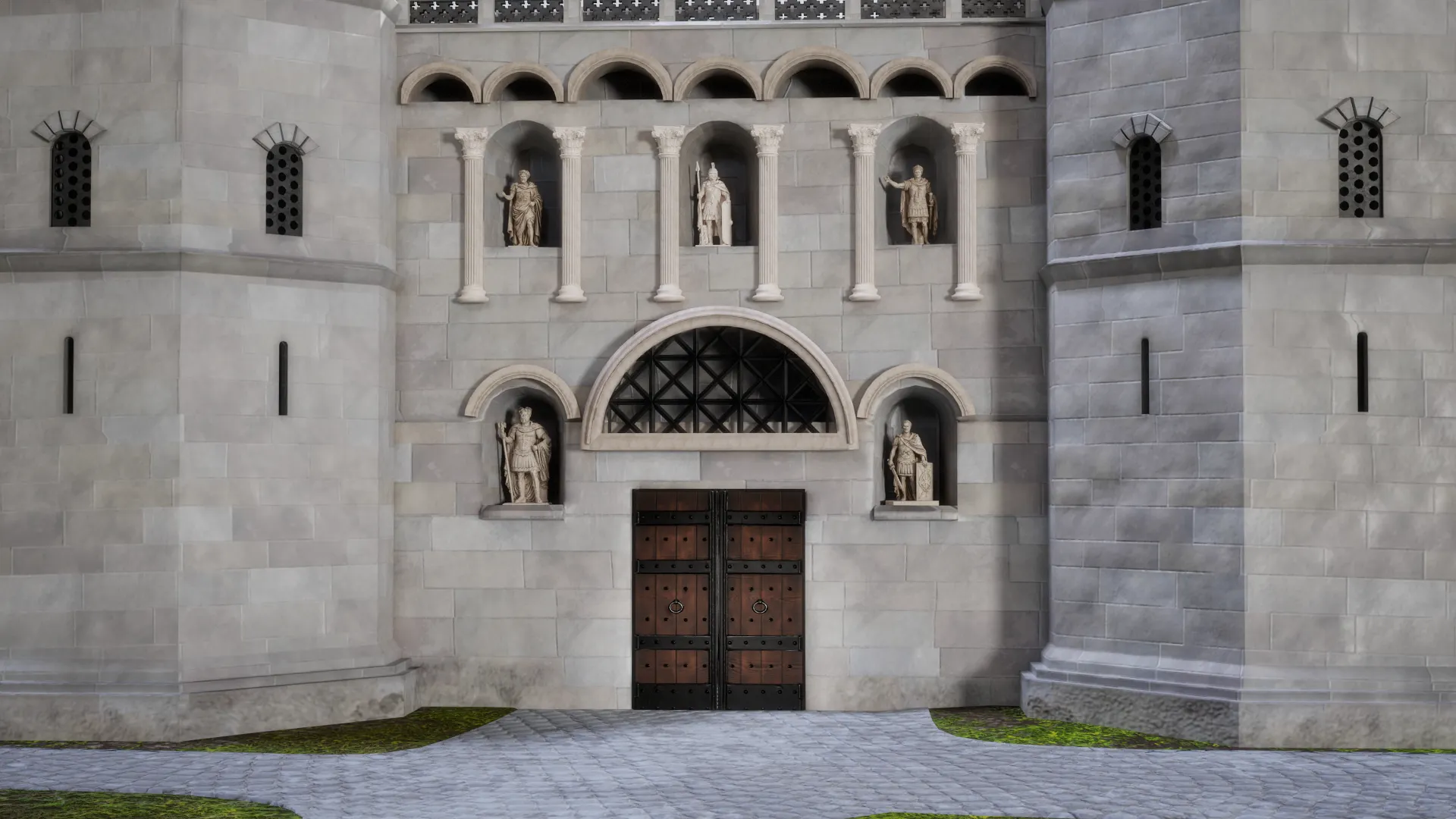
That is what Time Walk is built for. Our 80-minute small-group tour is led by a licensed local historian who walks you through all twelve of these details, and many more. At two key points in the tour — the Golden Gate and the Peristyle — you put on a Meta Quest 3 headset and see the palace reconstructed in full as it stood in 305 AD: the painted statues in their original colours, the gilded entrances, the Temple of Jupiter with its altar to the king of the gods, the Mausoleum as a working imperial tomb, the Peristyle filled with soldiers, dignitaries, and visitors.
It is, to our knowledge, the only way to see Diocletian's Palace as Diocletian saw it.
80 minutes · €25 · Small groups · Rated ★ 5.0 across 170+ verified reviews · Available in English
For broader visitor planning, our one-day Split itinerary places the VR tour at midday — after a self-guided sunrise walk through the palace — and builds the rest of the day around the historical centre Diocletian created. For deeper history, read our complete guide to Emperor Diocletian and our comparison of Split and Dubrovnik.
The best way to see Diocletian's Palace is a small-group guided walking tour with a licensed local historian, ideally one that includes a visual reconstruction of the original 4th-century complex. The palace is layered with seventeen centuries of continuous habitation — without context, most of what is historically significant is invisible. Self-guided walking covers the geography. A guide covers the meaning. A VR-enhanced tour like Time Walk adds the missing third dimension by reconstructing the palace as it stood in 305 AD.
Yes. Time Walk operates an 80-minute small-group walking tour that uses Meta Quest 3 headsets at two locations — the Golden Gate and the Peristyle — to reconstruct the palace exactly as it stood in 305 AD. The tour is led by a licensed Split historian and costs €25. It is, to our knowledge, the only VR-enhanced walking tour of Diocletian's Palace currently operating.
The bare minimum is about two hours — enough to walk the Cardo and Decumanus, see the Peristyle, enter the Cathedral of Saint Domnius, descend into the cellars, and visit the Temple of Jupiter. To actually understand what you are looking at, plan for half a day, ideally with a knowledgeable guide. The palace rewards slow, attentive walking.
Early morning (before 9 AM) or late afternoon (after 5 PM) in the high season (June–September). The Peristyle is at its most atmospheric just after sunrise, when the courtyard is empty and the light is low. Midday in summer is hot, crowded, and the worst time for photos. Spring and autumn are pleasant all day.
The 3rd-century stone frieze inside the Cathedral of Saint Domnius, which contains what are widely believed to be contemporary portraits of Emperor Diocletian and his wife Prisca. Most visitors enter the cathedral, look at the altar, photograph the bell tower, and leave without ever looking up at the frieze running around the dome.
Yes. The cellars (called the substructures or podrumi) are open to the public year-round. There is a small entrance fee for the developed sections. The central hall — where Game of Thrones filmed Daenerys's throne room — is the most impressive single space. The cellars preserve the original Roman floor plan of Diocletian's imperial apartments above and are one of the most important pieces of late Roman residential architecture in existence.
The palace itself is free to enter — it is a working city centre, not a closed monument. The four gates are open at all hours. Specific sites inside the palace (the Cathedral of Saint Domnius, the bell tower, the developed cellars, the Temple of Jupiter, the cathedral treasury) charge small entrance fees individually or as a combined ticket.
Roughly the outer walls, the four main gates, the Peristyle and its surrounding structures (cathedral/mausoleum, baptistery/Temple of Jupiter, Vestibule), and the substructures beneath the southern half. The buildings inside the walls are mostly medieval, Renaissance, and modern — built on top of, into, or against the original Roman fabric over 1,700 years of continuous habitation.
You can enter the palace for free, but without a guide you will walk past most of what makes it extraordinary. The signage is minimal, the most important details are unlabelled, and the building's history is layered too densely to interpret on your own. A good guide is the difference between seeing the palace and understanding it. Our VR-enhanced walking tour is built specifically to solve this problem.
Diocletian's Palace is a residential and administrative complex; the Colosseum is a public amphitheatre. The Palace at Split (c. 305 AD) was a working imperial residence and military garrison; the Colosseum in Rome (c. 80 AD) was a public entertainment venue. The Palace is two centuries younger but significantly better preserved as a complete structure — most of the Colosseum's interior is in ruins, while the Palace's gates, courtyard, mausoleum, temple, vestibule, and substructures all survive substantially intact.
The palace is the historic centre of Split. From Split Airport (SPU), take the airport shuttle bus or a taxi (about 25 minutes). From the Split bus station or the ferry port, the palace is a 5–10 minute walk along the Riva waterfront. If you arrive by car, park outside the historic centre — the palace is pedestrian-only.
Ana Marendić is a licensed tourist guide (turistički vodič) registered with the Croatian Ministry of Tourism and Sport. She conducts walking tours of Diocletian's Palace and Split's historic centre as the resident guide for Time Walk, a VR-enhanced walking tour of the palace. She is based in Split, Croatia.
This article draws on the author's professional guiding experience inside Diocletian's Palace, supplemented by primary archaeological and historical sources cited below. Facts about the sphinxes are taken from the conservation research conducted by the Croatian Conservation Institute. Dates for the Buvina doors are from the 2014–2018 Institute of Art History conservation project documentation. Architectural attributions follow Wilkes (1986), Marasović (1968), and the UNESCO World Heritage nomination dossier. Where claims are contested among scholars (for example, the identification of the dome frieze portraits as definitively Diocletian and Prisca), the article uses hedged language consistent with current scholarly consensus.
Want to learn more about us? Read our story.
Or browse more from our blog:
.png)