Summary
A rainy day in Split is not a lost day. The old town is a Roman palace, and a surprising amount of it has a roof: the vaulted cellars under the palace, the cathedral that was once Diocletian's mausoleum, and a handful of museums within a few minutes' walk of each other. Start in the cellars, add the cathedral and one or two museums, have a long lunch, and keep an eye on the sky. In Split, a wet morning often turns into a bright afternoon: even in November, the wettest month, the long-term average is about 9 days of rain, so most days stay dry.
Opening hours change with the season and many museums close one day a week, so check current hours before you set off.
How rain works in Split
Split averages about 81 days a year with at least 1 mm of rain, according to the long-term figures of the Croatian Meteorological and Hydrological Service (DHMZ). The most rain falls from October to January, and November is the wettest month, with about 102 mm spread over about 9 days. July is the driest, with about 3 rainy days. Summer rain is rare and usually arrives as a short, heavy storm that clears within an hour or two. In the colder months, a southerly wind (the jugo) can bring a grey, damp day or two, while the northerly bura brings cold, clear skies.

Show the numbers (DHMZ, 1971 to 2000)
| Month | Rain days (1 mm or more) | Rainfall |
|---|---|---|
| January | 7.9 | 74 mm |
| February | 7.2 | 61 mm |
| March | 7.5 | 63 mm |
| April | 7.7 | 62 mm |
| May | 6.6 | 62 mm |
| June | 5.7 | 47 mm |
| July | 3.3 | 26 mm |
| August | 3.8 | 45 mm |
| September | 5.8 | 69 mm |
| October | 7.6 | 82 mm |
| November | 9.1 | 102 mm |
| December | 8.6 | 91 mm |
| Year | 80.9 | 783 mm |
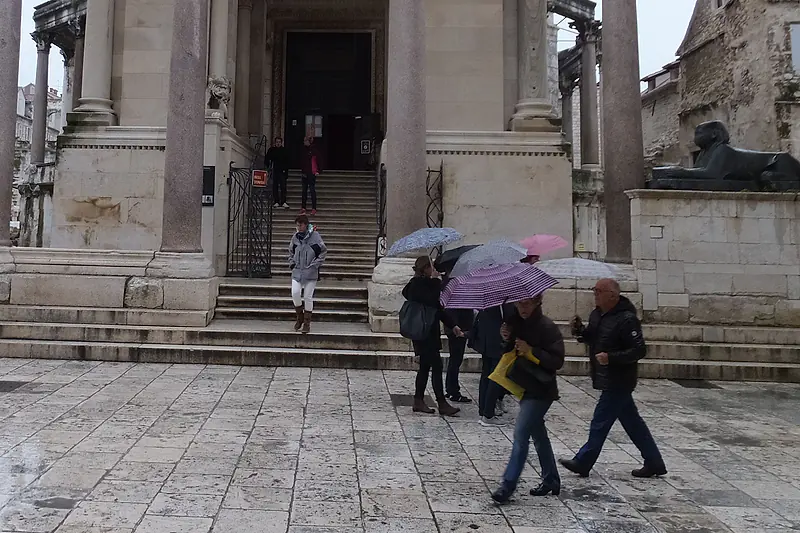
Two practical things locals know. First, the palace's polished limestone paving gets very slippery when wet, so wear shoes with grip. Second, an umbrella is more useful than a raincoat in the narrow streets, where you are mostly dodging drips from the eaves.
If you are still choosing your dates, our month-by-month guide to the weather in Split explains what each season is really like.
Start underground: the palace cellars
The best rainy-day sight in Split is directly under your feet. Diocletian built his apartments on a raised platform, and the vaulted halls that held it up still survive beneath the southern half of the palace. They are fully covered, stay a steady temperature all year, and give you the clearest idea of the size of the building that stood above.
The central passage runs from the Riva up to the Peristyle and is free to walk through. It is lined with craft and souvenir stalls, so it is also a sheltered shortcut through the old town. The large side halls to the east and west are the ticketed part. They are quieter, emptier and much more impressive, and fans will recognise them as the place where Daenerys chained her dragons in Game of Thrones. Our guide to palace ticket prices explains which ticket covers which part.
The cathedral, the crypt and the Temple of Jupiter
From the top of the cellar steps you come out on the Peristyle, and the cathedral is right in front of you. The Cathedral of Saint Domnius began life around 305 AD as Diocletian's own mausoleum, and it is still one of the oldest buildings in the world in use as a cathedral. Inside, look for the Roman frieze running around the dome and the carved Romanesque choir stalls.
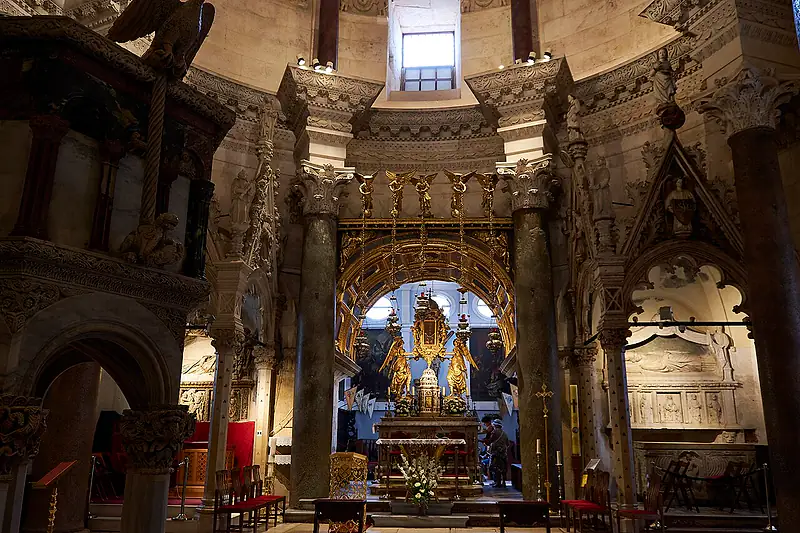
Below the cathedral is a small crypt, and a short walk west of the Peristyle is the Temple of Jupiter, later a baptistery, with a beautifully carved stone barrel vault. Both are small and quick to see, and both are dry.
Skip the bell tower in the rain. The steps are steep and partly open to the weather, and the view will not be at its best anyway.
Museums inside and around the palace
Several museums sit within a five-minute walk of the Peristyle. None of them is huge, which is exactly what you want on a wet day: an hour inside, then on to the next.
Split City Museum (Papalić Palace)
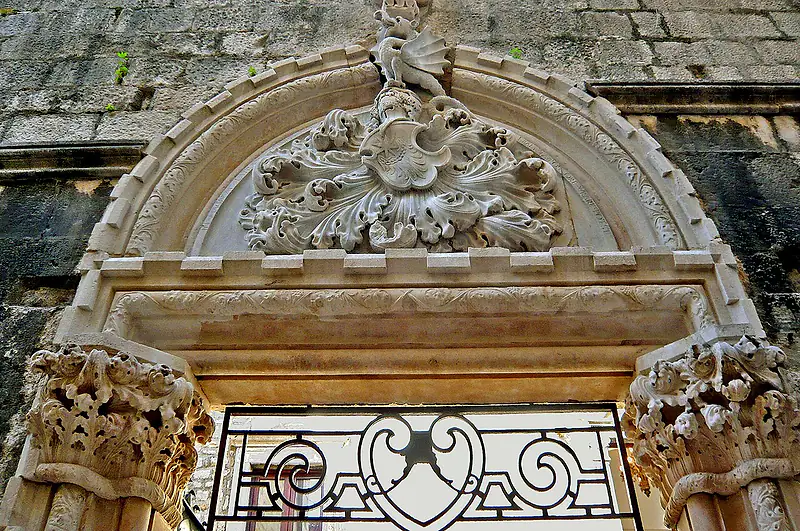
Hidden in Papalićeva Street, inside the palace walls, this museum fills a 15th-century Gothic palace built for one of Split's noble families. The building and its courtyard are as much the attraction as the collection, which covers the city's history from the Middle Ages onwards.
Ethnographic Museum
Close to the Vestibule, this museum shows traditional costumes, jewellery and everyday objects from Dalmatia. It is a good one to pair with the Vestibule itself. Note that the Vestibule's dome is open to the sky, so it is wet inside when it rains.
Gallery of Fine Arts
Just outside the palace, a few minutes from the Golden Gate, the Gallery of Fine Arts (Galerija umjetnina) holds Croatian and European paintings and sculpture from the Middle Ages to the present. Its calm, airy rooms are an easy place to sit out a heavy shower.
Froggyland
For something completely different, Froggyland, a few minutes from the palace walls, displays hundreds of stuffed frogs posed in human scenes: a school, a circus, a barber shop. It was made by one man, Ferenc Mere, in the early 20th century. It is odd and much loved by children.
Worth a short walk or bus ride
Archaeological Museum
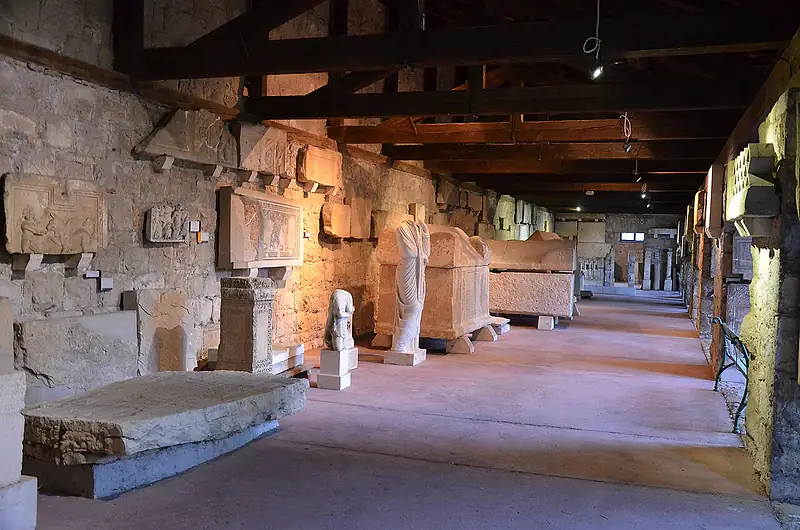
Founded in 1820, Split's Archaeological Museum is the oldest museum in Croatia. It is about a 15-minute walk north of the palace. Many of its best pieces come from Salona, the Roman city just outside Split, including sarcophagi, inscriptions and mosaics. A large part of the stone collection stands under covered arcades around the garden, so you can browse it even in a shower. If the weather clears, the ruins of Salona itself make a natural follow-up.
Meštrović Gallery
Ivan Meštrović, the sculptor of the Gregory of Nin statue, built this villa on the Marjan peninsula as his home in the 1930s. It now holds a large collection of his work in marble, bronze and wood. It is a pleasant walk along the seafront in good weather; in the rain, take a bus or taxi.
Rainy-day options compared
- Palace cellars: fully covered, 30 to 45 minutes, central passage free and side halls ticketed. Best for everyone, and Game of Thrones fans.
- Cathedral, crypt and Temple of Jupiter: covered, about 45 minutes in total, ticketed. Best for history and architecture.
- Split City Museum: covered, about 1 hour, ticketed. Best for a quiet look at medieval Split.
- Gallery of Fine Arts: covered, 1 to 1.5 hours, ticketed. Best for art lovers.
- Froggyland: covered, 30 to 45 minutes, ticketed. Best for children and anyone who likes the unusual.
- Archaeological Museum: mostly covered, 1 to 1.5 hours, ticketed, 15 minutes' walk. Best for Roman history.
- Meštrović Gallery: covered, 1.5 to 2 hours, ticketed, bus or taxi. Best for sculpture and a half-day outing.
Times are typical visit lengths, not opening hours. Prices and hours change, so check each museum's current information before you go.
Eat, drink and wait it out
Rain is the best excuse in Split for a long lunch. A konoba, the traditional Dalmatian tavern, is made for grey days: stone walls, a few tables and slow-cooked dishes like pašticada, beef braised in wine and prunes. Many cafés along the Riva have covered terraces, and locals will happily make a coffee last an hour.
If the whole day is wet and you have children with you, the shopping centres on the edge of town, such as City Center One and Joker, are where local families go. They are not sightseeing, but they are dry.
Taking a tour on a wet day
A guided walk is still worth doing in light rain. The palace is compact, and a good guide can link the covered spaces together and tell the stories while you stand under the arches.
Time Walk's 80-minute VR walking tour of Diocletian's Palace runs from March to November and starts at the Gregory of Nin statue outside the Golden Gate, where the guide holds a white umbrella. It costs €25 for adults, €15 for ages 10 to 17, and children under 10 join free (walk only, no VR). Groups are kept small. If it rains, you can choose: a guided walk without the VR scenes, a new time or day, or a full refund.
Private tours run all year. Because the time is yours, a private VR tour for your own group can be rescheduled to a drier slot or adapted to the weather on the day. Ask on WhatsApp or by email.
A sample rainy day in Split
- 9:30: Coffee under a covered terrace on the Riva.
- 10:00: The palace cellars, starting from the Riva entrance.
- 11:00: Up the steps to the Peristyle, then the cathedral and the Temple of Jupiter.
- 12:30: Split City Museum in Papalićeva Street.
- 13:30: A long lunch in a konoba.
- 15:30: Gallery of Fine Arts, or the Archaeological Museum if you don't mind a walk.
- Evening: If the rain stops, walk the Riva. The wet stone shines under the lights.
For a dry-weather version of the same day, see our one-day Split itinerary.
Frequently Asked Questions
What can you do in Split when it rains?
Visit the covered cellars under Diocletian's Palace, the Cathedral of Saint Domnius with its crypt, and the Temple of Jupiter. Then add one or two museums, such as the Split City Museum, the Gallery of Fine Arts or the Archaeological Museum. All are within walking distance of the old town.
Are the cellars of Diocletian's Palace covered?
Yes. The cellars are vaulted stone halls underneath the palace, so they are completely dry. The central passage from the Riva to the Peristyle is free, and the larger side halls need a ticket.
Which museum in Split is best on a rainy day?
For Roman history, the Archaeological Museum, the oldest museum in Croatia. For a short visit inside the old town, the Split City Museum in Papalić Palace. For art, the Gallery of Fine Arts by the Golden Gate or the Meštrović Gallery on Marjan.
When does it rain most in Split?
Most rain falls from October to January. November is the wettest month, with about 9 rainy days and 102 mm of rain on DHMZ's long-term averages, and July the driest, with about 3 rainy days. Summer rain is uncommon and usually comes as short storms that pass within an hour or two.
Do Time Walk tours run in the rain?
Group tours run from March to November. If it rains on your tour day, you can choose a guided walk without the VR scenes, a new time or day, or a full refund. Private tours run all year and can be rescheduled or adapted to the weather.
Is Split worth visiting in the rainy season?
Yes, if you come for the history rather than the beach. The palace is quieter, many sights are covered, and prices are lower outside summer. Rainy days are usually broken up by dry, clear ones.